
Student Name
Capella University
RSCH-FPX7864
Professor Name
Submission Date
Data Analysis Plan
For effective data analysis, there should be a systematic process for the collection of data and an analytical method for the analysis of the data. The approach will allow for a comprehensive review of the gathered data, which will help in creating valid research results (Tumiran, 2024). This research will try to investigate the possible relationship among the important factors affecting the students’ academic performances, which are the first quiz, final exams, cumulative points of the students in the course, and the previous GPA. The variables of the research are:
- In Test 1, A continuous variable that represents the number of correct responses obtained in the first test, with a scale of 0 up to the maximum possible score.
- Final Exam Score: the number of items correct on the final examination, on a scale of zero to the maximum possible, is a continuous variable.
- Total Points Earned: A continuous variable that is used to represent the total of all possible points that have been accumulated in an academic year.
- A continuous variable that represents a student’s past academic performance in a quantitative manner, ranging from 0.00 to 4.00 points. (Grade Point Average)
Total-Final Correlation
Research Question
Is there a statistically significant relationship present between the total number of points a student earns during a semester and performance in the final examination?
Hypotheses
Null Hypothesis (H0)
There is no statistically significant relationship present between the total points a student earns during a semester and performance in the final examination. H₀: ρ = 0.
Alternative Hypothesis (Ha)
There is a statistically significant relationship present between the total points a student earns during a semester and performance on the final examination.
Hₐ: ρ ≠ 0.
Quiz 1 and GPA Correlation
Research Question
Is students’ prior academic achievement, as measured by GPA, statistically related to performance in the first quiz?
Hypotheses
Null Hypothesis (H0): Students’ prior academic achievement, as measured by GPA, is not statistically related to performance in the first quiz. H₀: ρ = 0.
Alternative Hypothesis (Ha): Students’ prior academic achievement, as measured by GPA, is statistically related to performance in the first quiz. Hₐ: ρ ≠ 0.
Testing Assumptions
Table 1: Descriptive Statistics
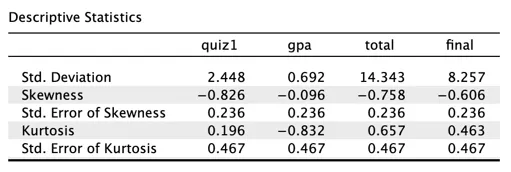
Making the assumption test in statistical analysis is one of the important steps to ensure that the results of the research are valid and reliable. Descriptive statistics show that approximately 73.82% of the students did better in the cumulative semester points and final exam results. Among the variables included, Quiz 1 had the most negative skewness (-0.826) while the GPA had very low negative skewness (-0.096), which is near symmetry. The skewness and standard deviation of all the variables considered were within acceptable levels.
The values for the variables ranged from −0.832 for GPA to 0.657 for total points earned, which were close to a normal distribution. There was no alarming trend in the measures of variability, and overall,l the data met the assumptions of being approximately normally distributed. In particular, the values of Skewness were less than the high limit of ±2.0 value as follows: total points earned: −0.758; GPA: −0.096; final exam performance: −0.606; Quiz 1 performance: −0.826. The skewness and Kurtosis values of the data between -2.0 and +2.0 are considered as approximately normal, which allows performing parametric statistical tests (Demir, 2022). Likewise, the values of kurtosis did not exceed ±3.0, further confirming the normal assumptions. The results of the correlation analysis showed that there was a strong and statistically significant positive association between total semester points and the performance of the students in the final examination, with r = 0.659 and p < 0.001, thus the null hypothesis was rejected. Conversely, Quiz 1 performance and GPA had a weak correlation that was not statistically significant (r = 0.142, p = 0.149), and the null hypothesis was maintained.
Results & Interpretation
Table 2: Pearson’s Correlations between Academic Performance Variables
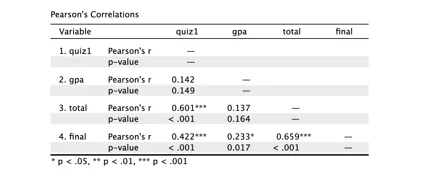
Pearson’s correlation coefficient (r) was used to measure the correlation between two continuous variables, where r is between −1 and +1, and the closer r is to +1 or −1 the stronger the correlation. Some interesting findings came from the correlation test. Cumulative semester points were significantly correlated with performance on Quiz 1 (r = 0.601, p < 0.001). Furthermore, Quiz 1 was moderately and significantly correlated with the final exam, with r = 0.422, p < 0.001. In contrast, grade point average (GPA) was also weakly correlated with performance on Quiz 1 (r = 0.142, p = 0.149), indicating that performance was not related to academic achievement on the initial assessments of the course.
Based on the classic definition of correlation coefficients, 0.10, 0.30, and 0.50 are small, medium, and large effect sizes, respectively (Zieliński, 2025). Also, the correlation between the GPA and the cumulative points won during the semester was weak (r = 0.137, p = 0.164), but it was not significant. Nevertheless, a weak but significant correlation (r = 0.233, p = 0.017) was found between GPA and performance on the final examination.
The highest correlation that was observed in the analysis was the total points earned in the semester and performance in the final examination (r = 0.659, p < 0.001). The above p-value is very small, meaning that the null hypothesis stating that there is no correlation between the performance in the semester and the result of the final exam can be rejected. Conversely, the null hypothesis with respect to the Quiz 1 score and the GPA was not rejected as it is not statistically significant. As a general rule, the findings of this study indicate that performance during the semester is a good guide to success at semester examinations, whereas that of previous semesters has little influence on the initial returns and appears to be of secondary importance towards the end of the course.
Statistical Conclusions
Some of the hypotheses were supported by the correlation analysis, which showed that a number of the academic performance measures collected at various assessment points have statistically significant relationships. There were significant relationships between a number of performance measures. There was a strong positive correlation between Quiz 1 score and total points earned during the semester (r = 0.601, p = 0.001) while the score in Quiz 1 was also weakly, but significantly, correlated with the final examination score (r = 0.233, p = 0.017).
But GPA was not significantly related to Quiz 1 performance (r = 0.142, p = 0.149), indicating that academic performance did not significantly influence initial performance in this course. The study showed that the value of p less than 0.05 is a statistically significant relationship, which does not occur by chance, and a p-value greater than 0.05 indicates that there is no statistically significant association (Zieliński, 2025). While GPA was weakly related to total points earned during the semester and performance on the final examination, the relationships with r = 0.137, p = 0.164 were not statistically significant.
The most significant correlation revealed in the analysis was that between cumulative semester performance and final exam performance (r = 0.659 at p < 0.001) which indicates very strong evidence against the null hypothesis. Overall, the outcomes suggest that a student’s current academic performance is a better indicator of how he or she will perform in the course than in the previous semester. Additionally, the weak and non-significant relationships that existed between past achievement and Quiz 1 scores suggest that there is very little past achievement that can predict success in the early part of the course.
Limitation
It is important to recognize that there are certain limitations that should be taken into account for the correlation analysis shown. While the correlations between the variables were significant, it is not possible to determine any causality as correlation analysis does not give any information about causality. In addition, the analysis did not take into account any confounding factors that may have influenced the relationships observed. The study was done by bivariate correlation analysis; it did not try to examine other, more complex relationships that could be examined using multivariate analysis, such as multiple regression analysis. The sample size was also relatively small, which may limit the generalizability of the results, especially when comparing the correlation between GPA and Quiz 1 scores.
Moreover, the fact that the analysis was conducted using only quantitative data means that there is limited understanding of the results. For instance, student learning styles, teaching styles, student engagement, and more were not considered. There are indications that the multiple regression analysis could help understand the multiple variables that impact academic outcomes, and that the variables have some overlapping effect on student performance, and that these variables can be understood at the same time (Erdem & Kaya, 2021). Considering the limitations will be helpful to enhance the efficiency of future studies.
Application
In nursing education and practice, it is common to use correlation studies to investigate important relationships between variables. For example, research can examine the relationship between the number of hours in clinical simulation and scores on the National Council Licensure Examination for Registered Nurses (NCLEX-RN) and how clinical simulation practicum hours relate to the successful completion of licensure.
Likewise, studies can investigate the relationship between nurse-to-patient ratios and medication errors in healthcare facilities, similar to how early academic performance, such as performance in Quiz 1, can be related to performance in subsequent tests. Furthermore, correlation studies could explore the correlation between post-discharge telephone follow-up and subsequent hospital readmission rates, showing how early interventions might affect subsequent outcomes in various health care environments.
The above examples show that correlation analysis can provide nurses with meaningful information regarding actual relationships between important variables in clinical, educational, and healthcare contexts. Correlation studies have provided evidence that has been used to enhance patient safety and the efficiency of the healthcare system by examining the relationships between desired health processes and health outcomes (Alwali, 2023).
The examples highlight the usefulness of correlation analysis in uncovering meaningful relationships that can be used to guide nursing research, inform clinical practice enhancements, and ensure effective health care interventions. The null hypotheses that were rejected in the statistically significant correlation analyses do support meaningful relationships that can inform evidence-based practice. The outcomes of the correlation analyses guide nurses to craft specific improvement strategies to tackle issues faced in delivering care and education (Hsin et al., 2025). Overall, correlation analyses have played a significant role in assisting with quality improvement programs, nursing care models, and making decisions based on data in healthcare systems.
References
Alwali, J. (2023). How high-involvement work practices, leadership and job crafting influence nurses’ innovative work behavior. Evidence-Based HRM: A Global Forum for Empirical Scholarship, 11(4), 709–724. https://doi.org/10.1108/ebhrm-01-2022-0010
Demir, S. (2022). Comparison of normality tests in terms of sample sizes under different skewness and kurtosis coefficients. International Journal of Assessment Tools in Education, 9(2), 397–409. https://doi.org/10.21449/ijate.1101295
Erdem, C., & Kaya, M. (2021). Socioeconomic status and wellbeing as predictors of students’ academic achievement: Evidence from a developing country. Journal of Psychologists and Counsellors in Schools, 33(2), 1–19. https://doi.org/10.1017/jgc.2021.10
Hsin, S., Lourenço, K., Porcello, A., Chemali, M., Marques, C., Raffoul, W., Cerrano, M., Applegate, L. A., & Laurent, A. E. (2025). Clinical safety and efficacy of hyaluronic acid–niacinamide–tranexamic acid injectable hydrogel for multifactorial facial skin quality enhancement with dark skin lightening. Gels, 11(7), 495–495. https://doi.org/10.3390/gels11070495
Tumiran, M. A. (2024). constructing a framework from quantitative data analysis: Advantages, types and innovative approaches. Quantum Journal of Social Sciences and Humanities, 5(4), 198–212. https://doi.org/10.55197/qjssh.v5i4.416
Zieliński, G. (2025). Effect size guidelines for individual and group differences in physiotherapy. Archives of Physical Medicine and Rehabilitation, 106(12), 1844–1849. https://doi.org/10.1016/j.apmr.2025.05.013